0 Results for ""
The developer is still the kingmaker. Their kingdom is getting much, much bigger.


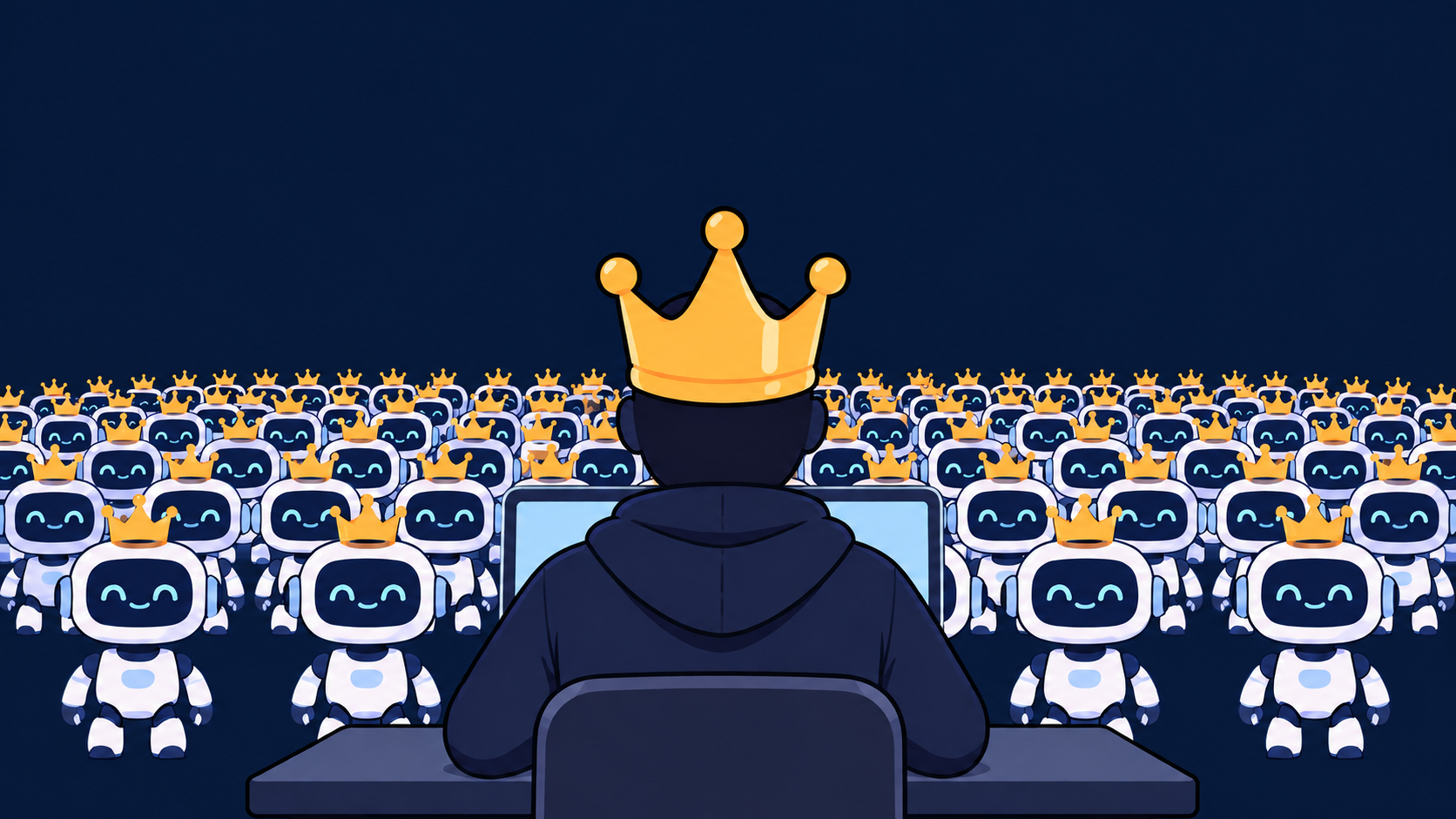
For most of software history, there was a fundamental constraint on how much software gets created: Human developer time.
With each major platform shift, developers have become more central to value creation. The cloud put more infrastructure decisions in developers' hands and dramatically expanded what they could build and deploy. But one developer was still fundamentally one unit of labor.
Agents allow developers to break free from that constraint.
As developers shift from writing code themselves to orchestrating fleets of agents, the amount of software that can be created is simply mind-boggling. Developers pushed nearly 1 billion commits to GitHub in all of 2025. As of this August, GitHub now sees 2.9 billion per month.
That fundamentally changes the math of the software industry.
The move to cloud forced a rewrite of the infrastructure stack, from compute and data to networking and security, creating enormous new categories in the process. Now, as software shifts from cloud-native to LLM-centric and agentic, we're entering another infrastructure rewrite, this time against a vastly larger unit of software output.
When software production is no longer constrained by human developer time, infrastructure categories that were built around human-scale consumption will become orders of magnitude larger.
1. Anthropic was an early signal
In our view, the rise of Anthropic* heralded that another major platform transition was underway, one that’s not limited to software development.
It’s a pattern we’d seen before.
In the cloud era, developers embraced AWS while there was still lots of skepticism around cloud computing. Their choices helped create an enormous downstream ecosystem of cloud-native infrastructure, which eventually became the default. When companies like HashiCorp* or Confluent showed up to sell to enterprises, developers already knew and loved them
That reinforced a simple investing framework: Follow the developer. I even wrote back in 2020 that developers were the modern-day kingmakers and that the next trillion-dollar software market will be driven from the ground up, with developers calling the shots.
When we evaluated Anthropic in late 2024 and early 2025, it was behind OpenAI in the eyes of consumers. But under the hood, there were signals that developers were quietly flocking to it. Claude 3.5 Sonnet had established a lead on widely watched coding benchmarks. After originally running on other models, Cursor had switched to Sonnet after its own internal evaluations and A/B tests. Co-founder Michael Truell has since described Sonnet 3.5 as a major jump. Anthropic's API business, in part powered by this demand from Cursor, really started to surge.
What was still an early signal became much more visible over the following year after we invested in early 2025. Claude Code became generally available in May 2025, a month after OpenAI launched the Codex desktop and agent app. Anthropic’s popularity among developers was evidenced across OpenRouter’s analysis of 100 trillion tokens, where Anthropic ultimately accounted for more than 60% of programming-related spend in 2025.
Developers crowned Anthropic.
Their behavior gave us an early signal that value was beginning to shift toward the models developers wanted to build around. While closed and open model competition remains intense, Anthropic’s growth has remained robust. Developers are diversifying their model choices, but Anthropic is a key pillar of developer strategies.
When all digital work ultimately compiles to code, developers are the critical bellwether for where AI goes next, and how it might reshape the infrastructure underneath.
AWS gave developers the infrastructure to build and run software; Anthropic is providing the intelligence layer for agents that can increasingly perform work themselves. Anthropic's economic impact (and OpenAI’s as well) will ultimately be larger than AWS's, because the market it is powering extends beyond software development to digital work across the economy.
2. So what gets built underneath?
If developers and agents create vastly more software (and eventually vastly more digital work) something has to run it.
This is where the infrastructure opportunity becomes enormous.
I remember saying 15 years ago that cloud would be the biggest shift in my career. But it’s clear that AI is much, much bigger.
In the cloud wave, Developers chose a new place to run software. AI changes not only where software runs, but:
- how software is created
- how much software gets created
- how applications behave
- who—or what—is operating them
- how much infrastructure they consume
We initially thought the LLM transition would require a handful of new infrastructure primitives. Instead, it is looking increasingly like a whole-stack rewrite.
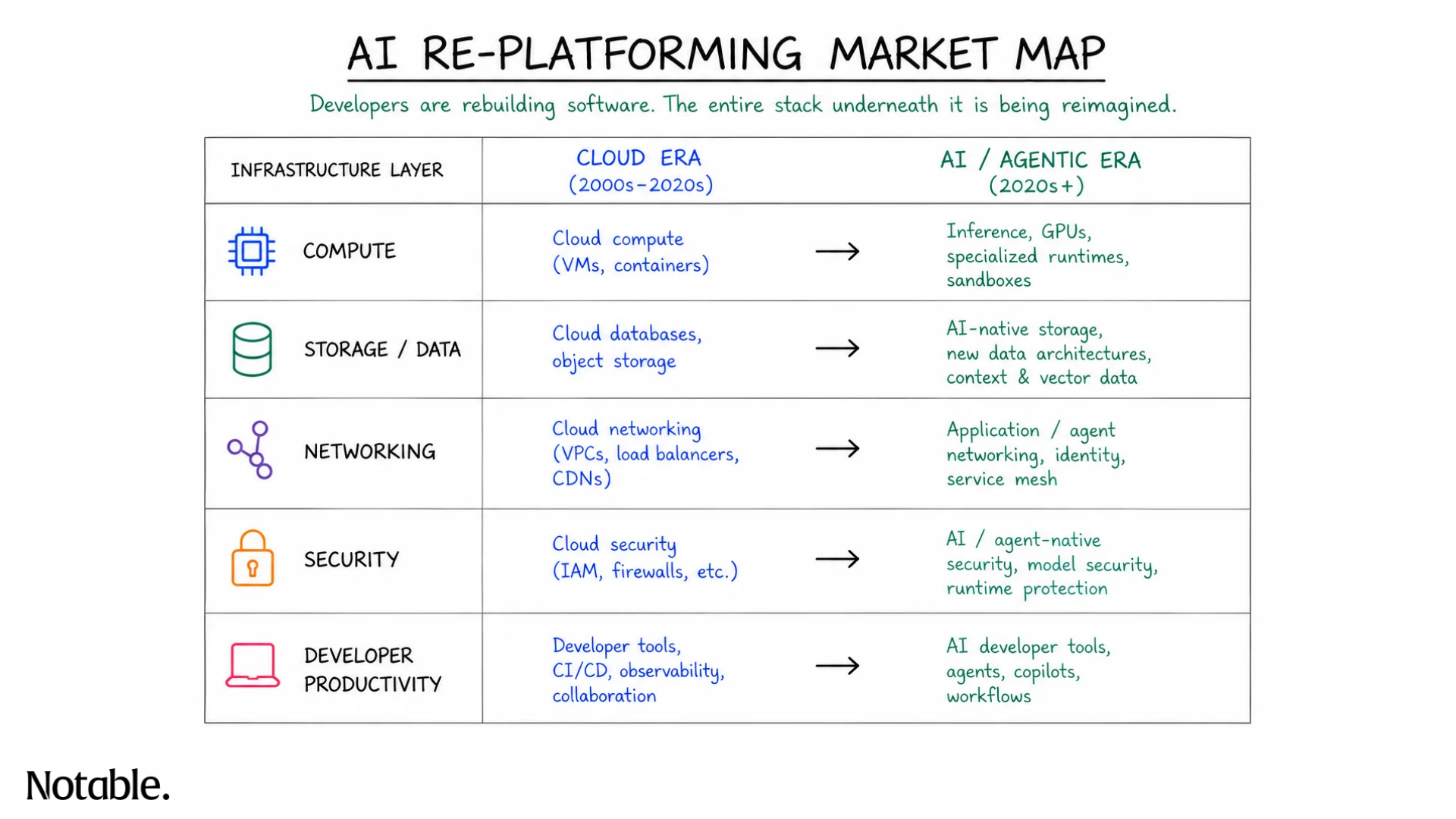
But the categories themselves are less interesting than how the opportunity within them is changing.
Compute was already enormous. AI is making it even more important and redistributing where value accrues. The shift from CPUs toward GPUs alone has reshaped the technology landscape; that’s why NVIDIA is the most valuable company in the world. Hyperscalers still play a very large role, but are at risk of being eclipsed by the frontier labs, who become the hyperscalers of the future. The open-source torch is being carried by inference providers, who have quickly become compute giants serving LLMs and gen media models. Additionally, as agent workloads grow, sandbox-based compute has skyrocketed, and winners are being crowned.
Developer productivity was a relatively small category. Even GitHub, one of the most important developer platforms in the world, costs relatively little per developer (between $4-21 per user per month). Agent productivity could make it one of the largest categories in the stack. Now, the same developer can potentially orchestrate tens of thousands of dollars (or eventually much more) of model inference, tokens, compute, and other infrastructure.
Storage, networking, and security remain comparatively open, without clear AI-native winners yet.
- Storage: Databricks established itself as the incumbent winner. Is storage for agents a different problem than storage for analytics?
- Networking: Does agent-to-service networking become its own layer, or get absorbed into compute and developer productivity?
- Security: The incumbents like CrowdStrike and Palo Alto Networks are performing very well and are continuing to acquire solutions to bolster their capabilities. But agent identity, permissioning, and isolation are still in flux. Who owns them?
There is still a ton of wood to chop to rebuild the stack for agents. Across these categories, there is room for billion- and trillion-dollar companies to emerge.
3. AI makes code abundant. Value moves to what runs it.
Abundance in code creates scarcity somewhere else: in the infrastructure, compute, and operational expertise required to execute it. That changes how the economics get divvied up.
In the cloud era, many infrastructure startups sold software that helped developers manage a workload: a specific job the underlying infrastructure needs to perform, like running a database, serving a web application, processing video, or executing a browser session.
Take a database. An infrastructure company might sell software that makes the database easier to manage, while the actual storage and compute required to run it still comes from AWS, Azure or GCP. The software company captures a relatively small attach rate (around 5-10%) on that cloud spend; the hyperscaler captures the bulk of the economics.
The value capture split is dramatic. The big three cloud providers together do ~$386B of ARR, as of Q2 2026 earnings. The software that helps customers run in the cloud does a fraction of that.
As the marginal cost of producing code falls, that already flawed model becomes much less attractive. The 5-10% attach rate goes to 1-2%.
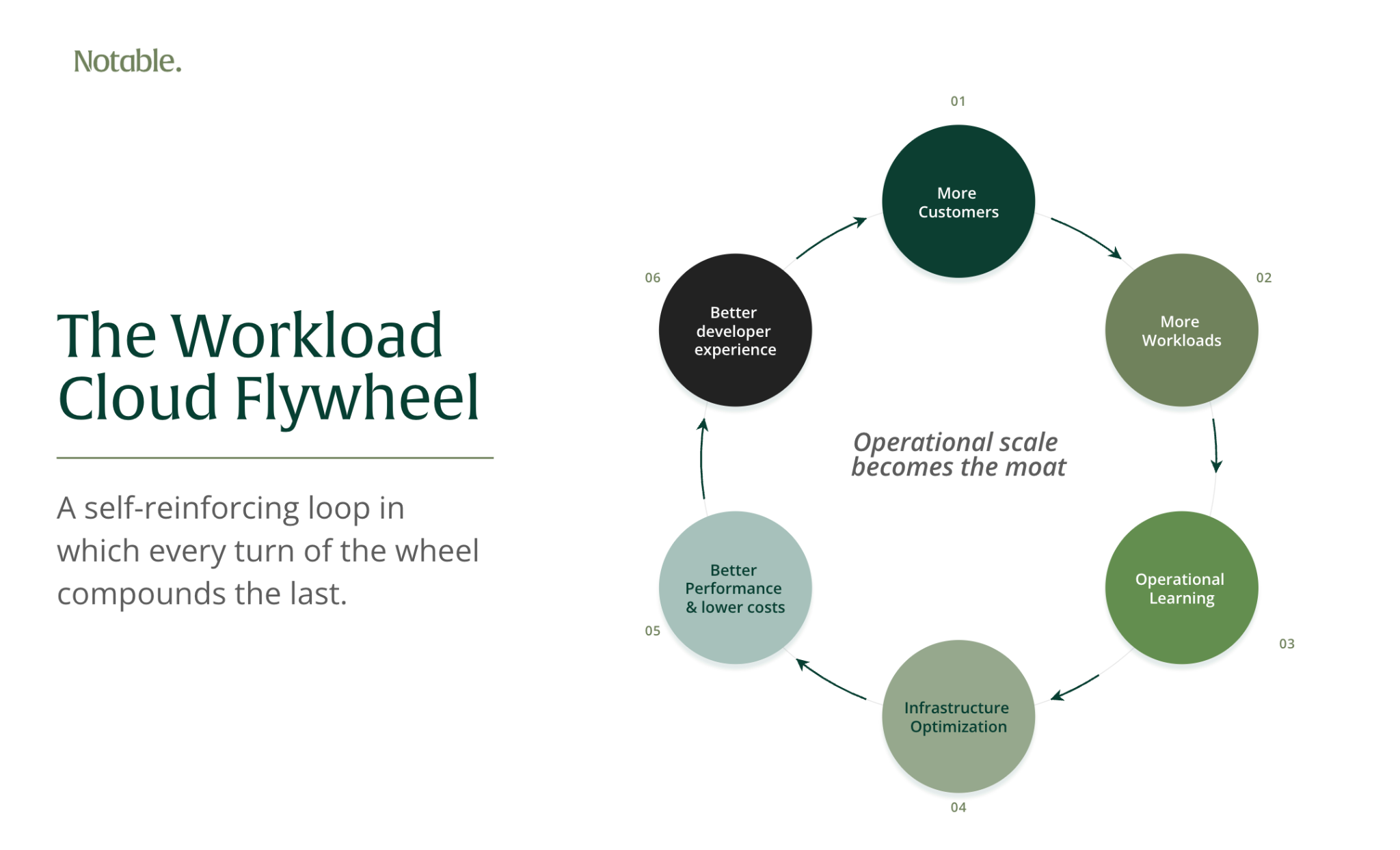
The answer for infrastructure startups is to stop looking like software providers and start looking like cloud providers: own the workload.
That's the opportunity behind workload clouds.
Instead of selling software around a workload, a workload cloud takes responsibility for running it:
Snowflake provided an early model in data: rather than simply selling data-warehouse software for customers to operate themselves, it became the infrastructure on which the workload ran.
Now we're seeing the model emerge across new workloads, from Vercel* in web and AI applications to fal* in generative media and Browserbase* in browsers. To go back to the developer here, one thing all of these companies have in common is that they nail the developer experience. And increasingly, nailing the developer experience means nailing the agent experience.
AI makes the workload cloud model even more powerful, because agents don't just produce more code. They create more workloads and continuously consume the infrastructure required to execute them. And as agents increasingly select and invoke infrastructure themselves, becoming the default place those workloads run becomes even more valuable.
The winners of this infrastructure cycle may therefore benefit twice: from dramatically more workloads being created, and from capturing a larger share of the economics of running each one.
4. Follow the developer
The cloud era taught us that the developer’s choices were an early signal of where the broader technology market was headed.
The same is true today.
We're already seeing companies that started out geared towards developers, expanding to a wider user base. Anthropic has expanded into broader knowledge work, with tools like Cowork and Claude Design. fal began as a developer-led platform for generative media infrastructure and is increasingly expanding beyond its core developer audience with new releases like fal agent. SpaceXAI (Cursor) released Grokbot, its personal AI agent. And there are countless other examples.
That's why what developers are doing with agents today matters far beyond software development.
What breaks when software becomes dramatically cheaper to create? What infrastructure becomes exponentially more valuable when agents are consuming it? Which markets that looked small in the cloud era become enormous in an agentic one? And which new categories haven't been invented yet?
The developer is still the kingmaker. But in 2026, this comes with an important addendum: The kingmaker is the developer, along with the agents at their fingertips.
*Indicates a Notable portfolio company