0 Results for ""
The Missing Infrastructure Layer for the Agentic Era


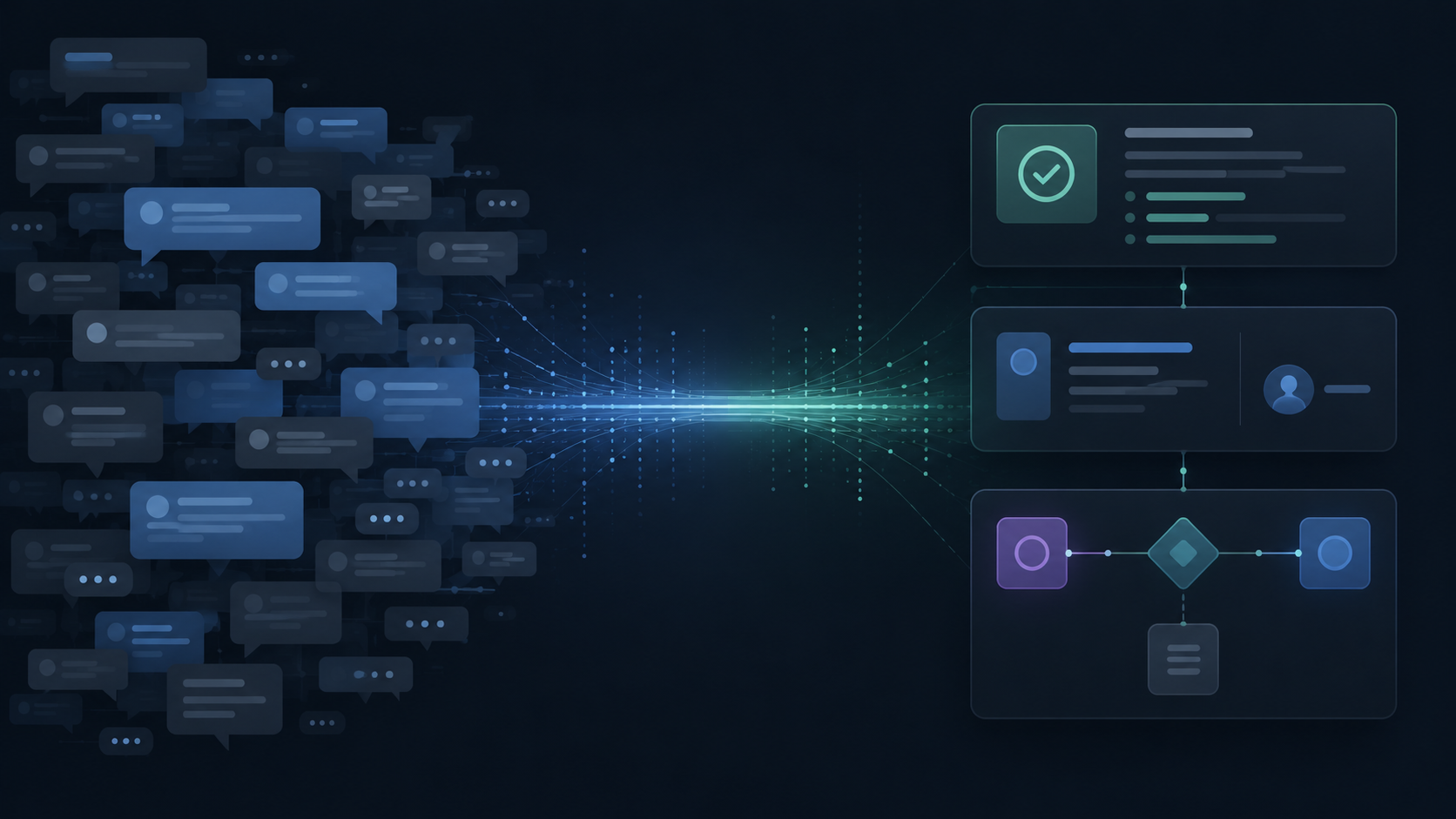
Somewhere in your Slack archive is a thread with a flurry of messages over several days going back and forth on an important product decision. Months later, nobody can find this thread and no agent can act on it. No system is aware it happened. And in the agentic era, it's about to get much worse.
Every major SaaS platform is now shipping its own agent, from Salesforce and Linear to GitHub Copilot and Zapier. Many organizations are also rolling their own agents for a variety of tasks as well. But these agents operate across fragmented contexts, tools, and execution environments with no shared coordination layer connecting them.
This is the agent sprawl problem, and it makes the question of where coordination lives suddenly urgent. A team of ten humans coordinating in Slack is manageable. A team of ten or more humans coordinating alongside dozens of autonomous agents, each acting across different systems with no unified view of state or progress, is chaos.
The AI era doesn’t need AI inside Slack or a better chat interface, but a layer that serves as the command center for both human and non-human participants. One place where teams can see what every agent is doing, intervene when needed, and ensure that execution across tools stays coherent.
Slack captured the communication layer of work. The next generation of tools must capture the coordination layer.
What Slack Doesn’t Enable Today
Slack was built to store unstructured conversations, not transform them. This is a fundamental design problem for the agentic era, because Slack today cannot reliably:
- Extract decisions from discussions: A product launch thread may contain a final pricing decision, rollout timeline, and risk tradeoffs, but that information remains buried inside chat history instead of becoming a structured artifact that systems can reference later.
- Convert commitments into tracked work: An engineer saying “I’ll handle the auth migration by Friday” still requires someone to manually create a Linear or Jira ticket, assign ownership, and track progress.
- Maintain persistent context across conversations: Teams repeatedly re-explain the same architectural decisions because context from prior discussions is fragmented across channels, threads, docs, and meetings.
- Provide structured inputs for AI systems: Agents cannot reliably operate on Slack conversations because messages lack structured state, ownership, dependencies, and canonical context windows.
- Turn conversation directly into action: A support escalation discussed in Slack cannot automatically trigger downstream workflows like spinning up an incident process, assigning responders, updating customer status pages, and coordinating remediation across tools.
The stakes of getting this wrong rise with every agent added. Today, a misread Slack thread is an annoyance. But in a world where that same thread can trigger a chain of automated actions across your entire stack (spinning up workflows, reassigning work, updating customers), it becomes a massive operational risk.
And while Slack has continued to augment its AI offerings within the tool, whether Slack AI, a bot, or a connected LLM, is still fundamentally optimizing the communication layer. It makes search better, summaries faster, and replies easier. But the underlying system remains the same: a stream of unstructured messages that humans send to each other.
Yet, despite its shortcomings for the AI age, I don't see a full Slack replacement happening, at least in the near term. Comms platforms encode company memory, workflows, integrations, and culture. Migrating away from them requires a massive behavioral reset across the organization. Because of this, very few tools successfully replace communication platforms once they become embedded in daily workflows.
Core Primitives of AI-Native Coordination
The more realistic path, instead of a full Slack replacement, is a system that layers above existing communication tools, continuously transforming conversations into structured context, tracked commitments, and executable state without requiring organizations to abandon the workflows they already rely on.
The next generation of coordination systems will be built around three primitives.
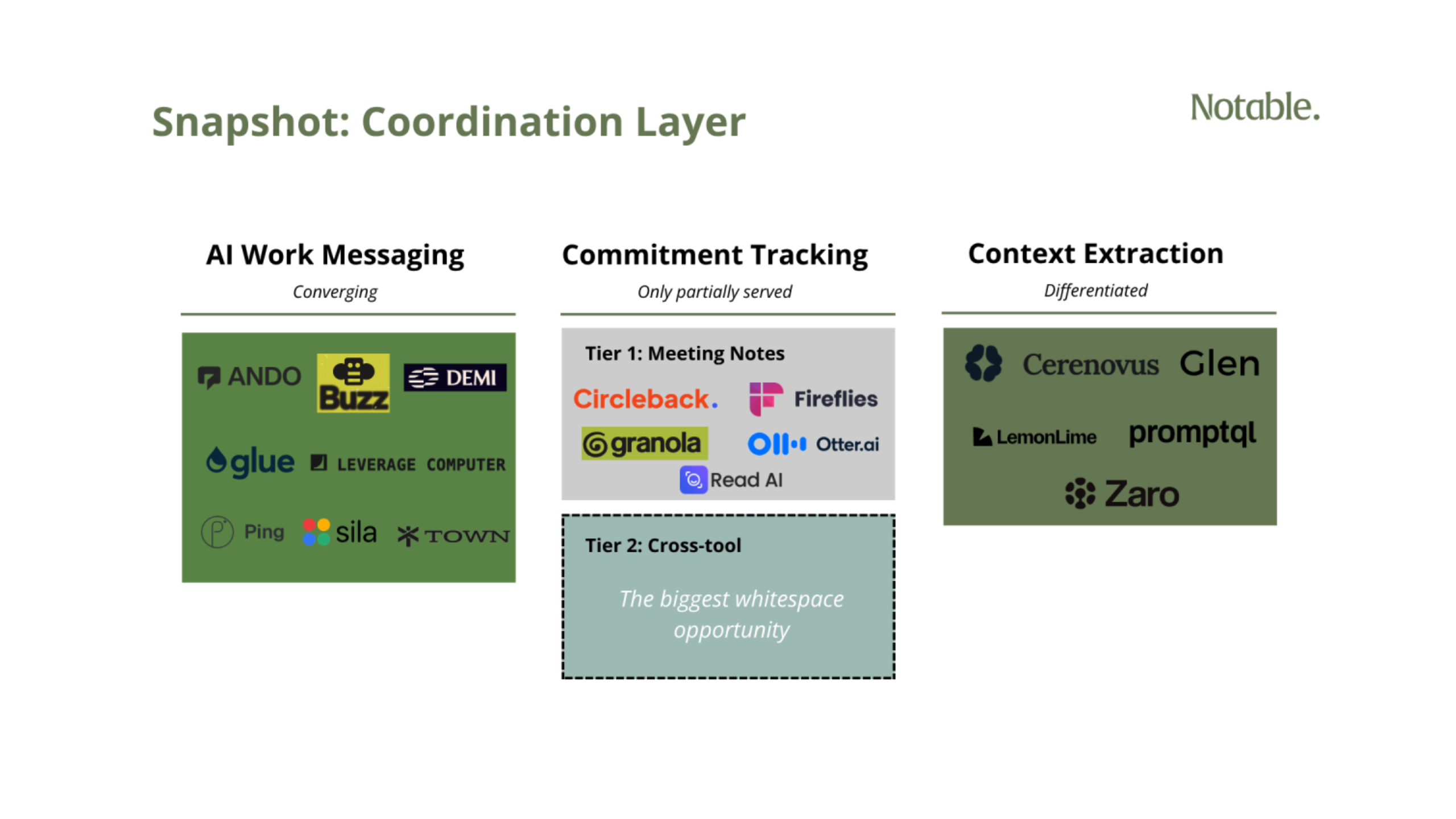
1. Context Extraction
Automatically distill conversations into a structured, machine-readable record that downstream systems can act on: decision extraction, knowledge graph creation, reasoning capture, context summarization (not just a better summary inside Slack).
For example, a 40-message product discussion about pricing could automatically generate:
- the final approved pricing decision
- unresolved risks
- owners who are directly responsible for follow-up work
2. Commitment Tracking
A cross-functional launch discussion involving engineering, support, and GTM automatically generates a shared execution timeline with owners, deadlines, and unresolved blockers surfaced across teams.
As work progresses, the system tracks status changes, identifies stalled dependencies, and flags when commitments are at risk of slipping without requiring teams to manually coordinate updates across Slack, Linear, or meetings.
The goal is to eliminate the manual coordination layer that currently sits between conversation and execution.
3. Agent Orchestration
Enable agents to act on structured context across systems.
For example, a Salesforce agent closing an enterprise deal could automatically trigger onboarding workflows, while a Linear agent creates implementation tickets, assigns dependencies across engineering teams, and tracks rollout progress. Humans only get pulled in when something fails, stalls, or requires approval.
This means coordinating workflows, supervising agent activity, retrying failures, escalating exceptions, and maintaining shared state across every tool and every agent in the stack. Netbox Labs CEO Kris Beevers recently wrote in depth about this here.
The Early Adopters Are Already Here
AI-native startups are already running multiple agents across multiple tools, and rapidly losing visibility into what those systems are doing. They’re viscerally feeling the absence of a shared coordination layer and will likely be the early adopters for the coordination OS. They closely resemble Slack’s original wedge: technical, fast-moving teams already overwhelmed by fragmented coordination.
The coordination layer needs to leave Slack. Decisions are disappearing into archives, commitments are dissolving into follow-up messages that never become tracked work, and agents are proliferating with no shared state and no one accountable for what any of them are actually doing. We're already seeing exciting startup activity emerge around the coordination layer and expect that pace to accelerate as agents become a larger part of everyday work. If you're building in this area, we'd love to learn more about what you're working on.